
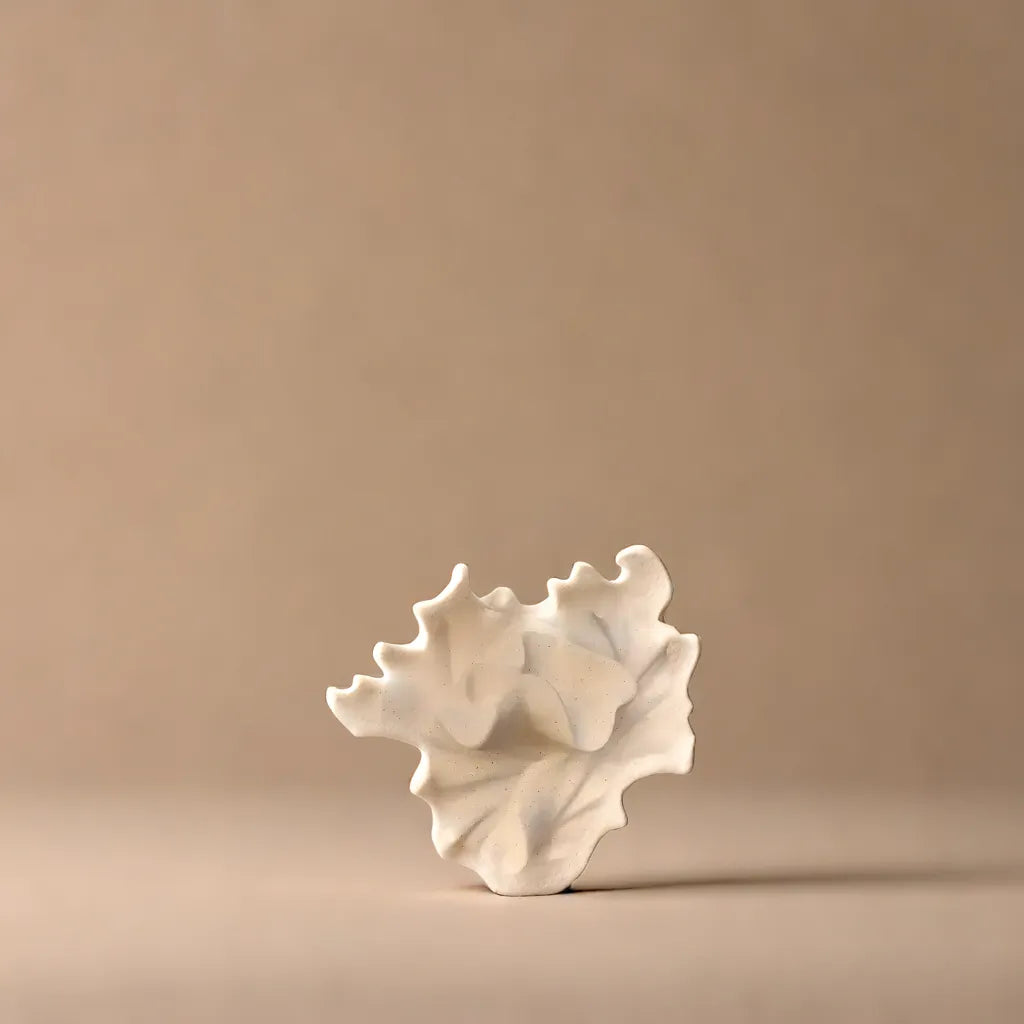
Every well-designed room tells a story. Some objects command attention the moment you walk in — a sculptural vase, an oversized canvas, a hand-carved console. Others quietly hold the room together: the small ceramic bowl on a shelf, the linen cushion, the slender candle holder. Both have a role to play. The art of interior styling lies in knowing how to balance them.
At Harmonia, we work with customers across Dubai and the UAE who are building homes that feel intentional — not overdone, not bare. This guide breaks down the practical rules for mixing statement pieces with everyday accents so your space feels curated, not cluttered.
What Is a Statement Piece?
A statement piece is any object that draws the eye first. It anchors a room visually and sets the tone for everything around it. In home décor, statement pieces are typically defined by one or more of the following qualities: unusual scale, bold form, distinctive material, or strong colour contrast.
Common examples include a large-format wall art above a sofa, an oversized sculpture on a plinth, or a floor-standing vase in a corner. These are the pieces guests notice and remember.
What Are Everyday Accents?
Everyday accents are the supporting cast. They add warmth, texture, and rhythm without competing for attention. Think smaller vases grouped on a tray, a set of matching candle holders, a stack of art books, or a woven basket tucked beneath a side table.
These pieces do the quiet work of making a room feel lived-in and layered. Without them, even the most striking statement piece can feel isolated.
The Core Rules for Balancing a Room
1. One Statement Piece Per Zone
Divide your room into visual zones — the seating area, the dining corner, the entryway. Each zone should have one clear focal point. If you place two equally bold pieces in the same zone, they compete rather than complement. Choose one to lead, and let the others support.
2. Use Scale Deliberately
Scale is one of the most powerful tools in interior styling. A large statement piece needs breathing room — surround it with lower, quieter objects so it can be seen clearly. Conversely, a collection of small accents can feel more impactful when grouped together rather than scattered individually across a surface.
3. Repeat Colours and Materials
Repetition creates cohesion. If your statement piece is a terracotta sculpture, echo that warm tone in a smaller ceramic accent or a cushion nearby. If your wall art features deep navy, pick up that colour in a smaller object on a shelf. This technique ties the room together without making it feel matchy.
4. Vary Heights and Shapes
A flat, uniform arrangement feels static. Mix tall and low, round and angular, matte and reflective. A tall sculptural vase next to a low, wide bowl creates visual movement. This contrast keeps the eye moving through the space rather than stopping at one point.
5. Edit Ruthlessly
The most common mistake in home styling is adding too much. If a room feels busy, remove pieces one by one until the statement piece can breathe again. A well-edited room always looks more considered than a full one.
Practical Checklist: Before You Style a Surface
- Have you identified one clear focal point for this zone?
- Is there a mix of heights — at least two different levels?
- Do the colours or materials echo something elsewhere in the room?
- Are there odd numbers of grouped objects (3 or 5 tends to feel more natural than 2 or 4)?
- Does the arrangement leave enough negative space around the statement piece?
- Would removing one item make the overall composition stronger?
Applying This in UAE Homes
Homes in Dubai and across the UAE often feature generous proportions — high ceilings, open-plan living areas, and large windows. This gives you more freedom with scale, but it also means small accents can get lost. In these spaces, statement pieces need to be genuinely large to hold their own: a floor sculpture that stands at least 60–80 cm, a wall art piece that spans at least half the width of the sofa beneath it, or a vase tall enough to be seen from across the room.
For everyday accents in larger rooms, grouping is key. Three small objects together read as one mid-sized element — which is exactly the visual weight you need to balance a large statement piece on the opposite side of the room.
When to Break the Rules
These guidelines exist to help, not to constrain. Some of the most memorable interiors deliberately break one rule to create tension and personality. A room full of statement pieces can work — if they share a consistent material palette. A room with no obvious focal point can feel intentionally calm and meditative. The key is to break rules consciously, not accidentally.
If you are unsure whether your space is working, step back and take a photograph. The camera flattens the room and makes imbalances easier to spot than the naked eye.
Frequently Asked Questions
How many statement pieces should a living room have?
As a general rule, one to two statement pieces per room is enough. In an open-plan space, you can have one per distinct zone — for example, one in the seating area and one in the dining area — as long as they are separated by enough distance to avoid competing.
Can everyday accents become statement pieces?
Yes — context determines impact. A single small sculpture on a large empty shelf becomes a statement through contrast and negative space. The same object on a crowded surface disappears. Placement and scale relative to surroundings matter more than the object itself.
What is the easiest way to refresh a room without buying new pieces?
Rearrange what you already have. Move a statement piece to a different zone, regroup your accents, or remove a third of the objects from a surface. Editing and repositioning often has more impact than adding something new.
Where can I find statement pieces for my home in Dubai?
Harmonia carries a curated selection of sculptures, vases, and wall art suited to UAE homes. If you need help choosing pieces for a specific room, get in touch with our team — we are happy to advise.


Leave a comment
This site is protected by hCaptcha and the hCaptcha Privacy Policy and Terms of Service apply.